9
Min read
We thought now would be as good a time as any to take stock of where things stand in AI policy. We could roll out a laundry list of proposals and ideas (and maybe we will in future), but the hardest thing to do in policy is to prioritize.
Therefore, we'll start what will hopefully be a series by making the following argument: in order to cement and extend its leadership in AI and reap the economic benefits, the US government should focus its energies on reaching two specific goals—a moratorium on state AI regulations, and passing permitting reform.
We have already written extensively about the state AI issue.
We are already seeing what happens when 50 state capitols all decide they’re the global AI regulator. California alone passed 18 AI-related laws in 2024, ranging from rules on digital likeness to sector-specific guidelines, and has repeatedly flirted with sweeping “frontier model” bills such as SB 1047 and now SB 53. Meanwhile, more than 1 000 AI bills have reportedly been introduced in state legislatures nationwide, prompting serious concern inside industry that compliance will become a de facto tax on innovation and a barrier to entry for smaller firms.
This is not an abstract worry. AI models are inherently interstate: trained on global data, deployed over national cloud networks, serving users in every state in milliseconds. The traditional American answer, going back to railroads, aviation, telecoms and the internet, has been federal primacy over interstate networks.
The permitting issue is also key.
Leading in AI means building enormous data centers, high-voltage transmission lines to power them, manufacturing facilities for chips and transformers, and the pipelines, ports and mines that underpin all of that.
As writers will no doubt already know, America's byzantine permitting system makes it much too hard to build many of these things. While there has been a lot of good executive action, and courts are trending in the right direction, some obstacles have to be lifted at the statutory level.
What is needed is statutory reform with teeth: firm shot-clocks on NEPA reviews, real limits on serial litigation and duplicative state processes, expanded categorical exclusions for well-understood project types, and clear priority status for infrastructure that directly supports AI capacity and energy security. There are good bills currently pending in Congress. They should pass.
Policy News You Need To Know
#MediaBias — White House has launched a mediabias tipline for reports of non-factual reporting and dishonest journalism. The results are cataloged here. Reporting us to this tipline is strictly prohibited.
#WhatOligarchs — In a very interesting move, Michael Dell and his wife have announced that they will donate $6.25 billion to endow Trump Accounts for all children born in America. Trump Accounts are IRA-like savings accounts, trusteed by the Treasury dept, that invest in nonleveraged index funds. Americans born between Jan 1 2025 and Dec 31 2026 will receive a one time contribution of $1,000 from the Treasury when the account is opened. The account is eligible for contributions up to $5,000 annually from families, employers, and charities.
#IsOurChildrensLearning #NewWoke — By now you've at least heard about this striking piece at The Atlantic which includes some pretty shocking stats: at Brown and Harvard, more than 20% of undergraduates are registered as disabled; at Amherst more than 30%, and at Stanford nearly 40%. Disability is the New Woke.
#Fraud — A GAO sting operation has detonated under the ACA, with investigators reporting that the federal exchange approved subsidies for 23 of 24 completely fictitious applicants and left 18 of them still actively enrolled as of September 2025. Brian Blase at the Paragon Health Institute has a good writeup of the report. GAO also found that more than $21 billion in 2023 advance premium tax credits show no evidence of the legally required reconciliation through tax returns, after the Biden administration effectively suspended enforcement from 2021 through 2024, and that tens of thousands of Social Security numbers were reused, including one identity that generated the equivalent of 71 years of subsidized coverage and nearly $100 million in subsidies linked to deceased enrollees. Yikes.
#PublicPurchasing — The Department of War has published a drone purchasing schedule, beginning February 2026. This is a small revolution in public procurement, because in doing so it ensures consistent demand for drones, which in turn drives investment much more reliably than one-off programs.
#VotingRights — DOJ has brought suits against Delaware, Maryland, New Mexico, Rhode Island and Vermont for failure to provide voter rolls. This brings the count of States being sued to 12. Suits against California, Michigan, Minnesota, New York, New Hampshire, and Pennsylvania were filed in September.
#MFN #DrugPricing — The Trump administration today announced a deal with Britain that, if it holds, could mark the beginning of the end of the rich-world free-rider problem in drug pricing. Under the deal, struck within the broader US-UK Economic Prosperity framework, London pledges to reverse a decade of declining NHS spending on innovative medicines, raise net prices for new drugs by 25 %, and cap clawbacks under its VPAG rebate scheme at 15 %, while Washington will exempt UK drugs and devices from Section 232 tariffs and pledges not to target British pricing under Section 301 during Trump’s term. In policy terms, this is the concrete application of Trump’s “most-favored-nation” approach: instead of importing foreign price controls into Medicare, he is exporting higher prices to allies and using trade leverage to do it. If other developed countries follow Britain’s lead, the global reference basket that drug companies use will shift upward, which should ease the subsidy that American patients have long provided to socialized systems abroad and give US conservatives a stronger argument against domestic price controls.
#BlueGovernance — By now you surely have heard about the banana republic-tier Minnesota welfare fraud scandal. Well, in another shining example of Blue governance, DOT's investigation into Minnesota has found that California wasn't the only state issuing illegal CDLs.
#BlueGovernance — Speaking of. DHS has launched an operation in New Orleans after criminal aliens were released from incarceration rather than turned over to immigration enforcement. This non-compliance is the explicit policy of sanctuary cities. The good folks at the Center for Immigration Studies has put together a useful map and explainer.
Chart of the Day
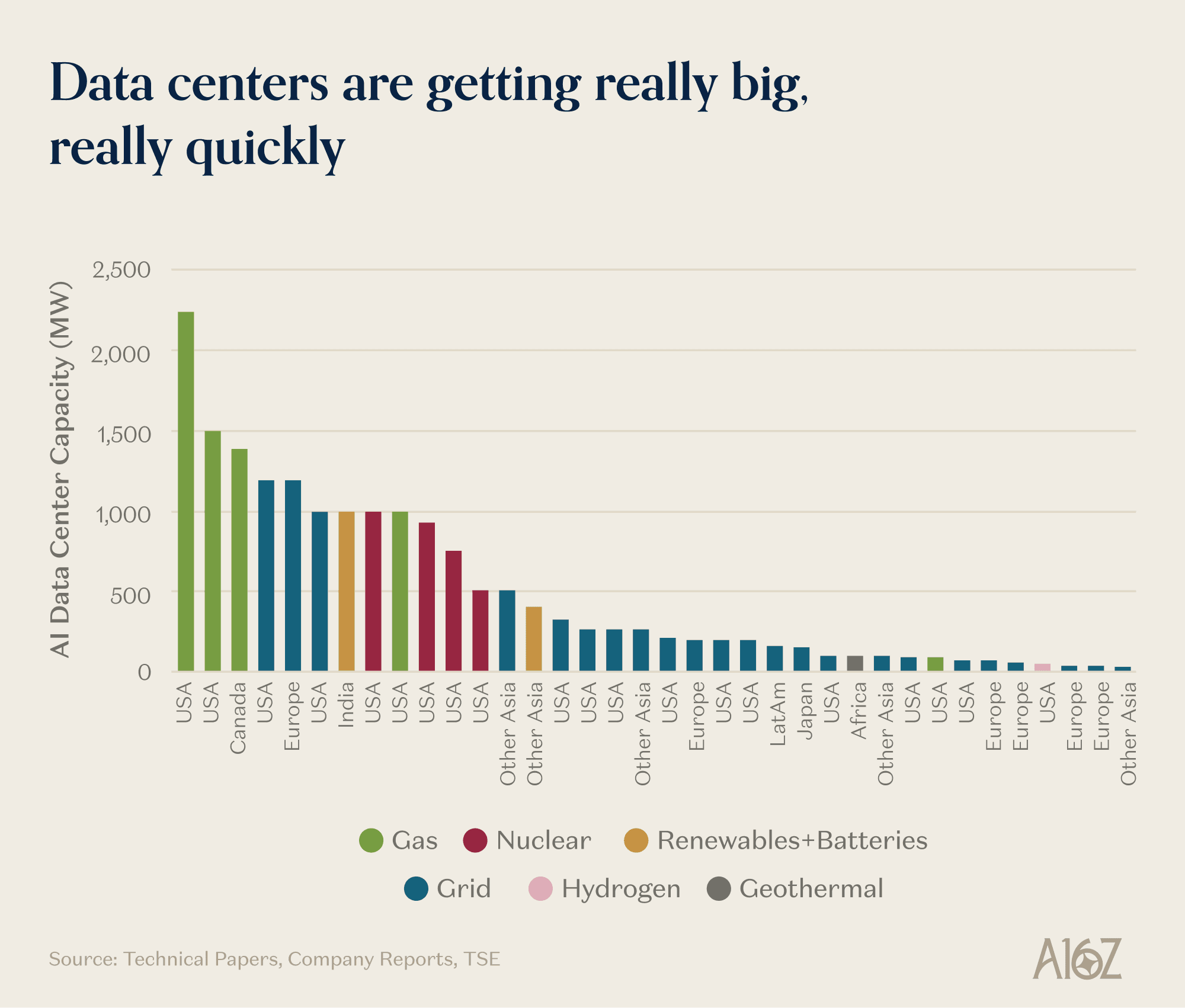
Interesting chart from A16Z's new and cool "Charts of the Week" feature.