11
Min read
First of all, an apology. Your correspondent had to have surgery last week to address a breathing issue. He is now out of danger and on the path to recovery, but for the past week or so we have been unable to write the Briefing, for which we apologize.
This will be the last Briefing until next year. Merry Christmas to all of you! Thank you for your support which makes this possible.
Perhaps the biggest policy news of last week was a highly publicized signing of an Executive Order by the President, which is mainly (but not only) concerned with rescheduling marijuana. To explain the EO, we spoke to Luke Niforatos of Smart Approaches to Marijuana.
And yes: full disclosure, while PolicySphere seeks to fairly present every right-of-center position fairly from a neutral perspective, on this issue we are not neutral. We think marijuana, like all drugs, is bad, and we think that the Federal government should crack down on it.
Niforatos is one of the smartest voices on drug policy. We've previously interviewed him twice, once on the specific issue of rescheduling, and on the Sphere Podcast on broader issues related to marijuana policy (Spotify, Apple Podcasts, YouTube), which we strongly recommend. So we spoke to him earlier this morning about the EO. The following interview was lightly edited for clarity.
PolicySphere: What does the executive order do, exactly?
Luke Niforatos, Smart Approaches to Marijuana: It directs the Department of Justice—specifically Attorney General Pam Bondi—to move forward quickly with the Biden-era rule to reschedule marijuana. That rule is currently waiting for formal hearings at the Drug Enforcement Administration. I assume they’ll appoint another administrative law judge and begin proceedings. My organization, Smart Approaches to Marijuana (SAM), is an interested party, so we’ll participate and cross-examine witnesses.
The second piece is that the order directs Dr. Oz, the head of the Centers for Medicare and Medicaid Services, to make CBD products available to seniors and other Medicare beneficiaries—by April of next year, they say. So it focuses on rescheduling marijuana to a lower schedule and making CBD products available.
PolicySphere: Briefly explain why you think that’s bad.
Niforatos: Moving marijuana down to Schedule III is very bad because, despite what the president is saying, it’s not just about research. Schedule III gives the marijuana industry—recreational and medical—access to more than $2 billion in tax write-offs, because they’ll be able to deduct business expenses.
The most concerning expense is advertising. We know the marijuana industry relentlessly advertises to kids using child-friendly packaging, bright colors, even Sesame Street characters—child-friendly products of all kinds. Those activities become more financially attractive under Schedule III, and we can expect more of it.
It also makes the industry more profitable overnight. They’ll have a stronger balance sheet to present to investors. So what Trump is doing, effectively, is normalizing the industry and making it easier for it to expand nationwide. We’re very concerned about that.
And big-picture, it sends the wrong message—especially when support is souring across Republicans, independents, and Democrats.
PolicySphere: The event around the executive order focused a lot on research and “medical marijuana.” The President argued this is about facilitating research. What's wrong with that?
Niforatos: We already have more than 50,000 research studies on marijuana, and new studies come out all the time. A New York Times article yesterday highlighted a major study finding that many of the medical uses being promoted for marijuana aren’t supported.
PolicySphere: Well, the New York Times is a famously socially conservative newspaper, so you would expect to publish something like that.
Niforatos: (Laughter.) Right. It says something that the Times came out with a story like that. Anyhow, when the President said that rescheduling needs to happen for research to happen—that’s not true.
On CBD, I’m also very concerned. They’re framing this as an “innovation model” for medicine, but I see it as regressive. They’re going to allow Medicare beneficiaries to get taxpayer-funded CBD products from so-called “legitimate sources,” but the FDA has not set regulations that make those sources legitimate. We don’t know what companies will supply these products.
And what we’ve seen across the CBD industry is that many products contain significant amounts of THC. So we’re concerned this becomes a backdoor way for marijuana products—or highly tainted, impure CBD products—to be distributed with taxpayer money.
It’s also like crowdsourcing medicine. We do clinical trials so we don’t expose patients to dangerous products before they’re ready. This is more like: let millions of seniors use it, and if it hurts them, they’ll report it, and we’ll learn from that. I don’t think that’s acceptable.
PolicySphere: CBD is the non-psychoactive component in the marijuana plant, correct? Some would say CBD products are basically placebo—maybe they don’t do much, but they don’t hurt anyone either. So what’s the big deal?
Niforatos: That’s what they say, but newer research suggests CBD may have harmful effects on the liver, especially with extended use. There are also other emerging concerns, and we’re seeing FDA warnings.
It was initially thought CBD was harmless—maybe a placebo—but the jury is still out. And the Trump administration’s approach sounds like: get everybody using it, have taxpayers fund it, and hope it works out. That’s a scary way to do medicine.
PolicySphere: Can you talk about the “medical marijuana” angle? The event around the EO talked a lot about medical uses of marijuana. Aren't there legitimate medical uses for marijuana? Is this executive order concerned with those, or is it effectively creating more loopholes for more legal pot?
Niforatos: The executive order doesn’t really do anything for medical marijuana beyond continuing research that’s already happening—and giving the industry a major tax break if it moves to Schedule III. That’s the practical impact.
As for the medical claims, a lot of them have been debunked. One of the biggest misnomers is marijuana for PTSD. At the ceremony, President Trump had veterans’ groups there thanking him for what they described as groundbreaking for veterans. But there’s a major literature review of more than 500 studies on veterans that found medical marijuana use is counterproductive for anxiety and PTSD—it can exacerbate those diagnoses. It’s troubling to use veterans for the imagery when the research so far doesn’t support the claims.
There are limited instances where marijuana-related products have FDA-approved medical value. Marinol, which is pure THC, can help some cancer patients with appetite. And there’s a pure CBD medication approved for very rare seizure disorders. But that’s not the CBD being sold in stores, and it’s not what Trump was talking about. Beyond that, it’s not approved for other uses at this point, and I don’t think future research is likely to change that in a major way.
PolicySphere: We're glad you mentioned the veterans-with-PTSD thing, because we hear about it a lot. Recently, Joe Rogan was saying on his podcast that he has a veteran friend with PTSD and the only thing that helps him is marijuana. You’re saying that’s not true?
Niforatos: There are anecdotes. Maybe it works for one or two people. But when you look at the data across large studies—hundreds of thousands of veterans—the vast majority are harmed by these products, not helped.
If someone gets really intoxicated—whether by alcohol or marijuana—they may not feel the acute effects of PTSD in that moment. But the high wears off, and the underlying problems remain. That’s a lot of what we’re seeing.
PolicySphere: Let’s talk politics. In 2024, President Trump essentially created a new coalition, the first time since 2004 that we had more than 51% of the public voting Republican. And a lot of those new voters, or so this argument goes, are younger men, who are not socially conservative and lean more libertarian, podcast bros and the like, and that loosening regulations on marijuana is good politics because it helps maintain this expanded coalition. What’s the counterargument?
Niforatos: Politically, I think this loses Trump more than it gains.
If you ask voters whether they have an opinion about marijuana, many do. But it’s not driving them to the polls. Gallup and Pew track the top reasons voters turn out. Marijuana is never in the top 20.
There’s been talk about a “cannabis vote,” but we’ve never seen research showing this issue turns people out or gets candidates elected. I’m open to being convinced, but the data isn’t there.
People vote on bigger issues: jobs, the economy, health, wars. That applies even to libertarian-leaning voters.
And the reason I think it loses more than it gains is that many of those voters will be indifferent. Meanwhile, parents, families, and social conservative voters—who are critical to winning any Republican election—are deeply upset. More than 22 senators, House and Senate Republican leadership, and multiple conservative groups came out against this. Those voters are paying attention, and they’re not happy.
PolicySphere: There is this meme that the public is changing its views about marijuana, and certainly you can find anecdotes to support it. You see people on X saying things like "I used to support legal marijuana but now that there's pot smell on the streets everywhere I've changed my mind." But we have to be careful about wishcasting and projecting our views on the public. What do you think? Is there real evidence of a trend?
Niforatos: I think people are changing their minds.
Look at Massachusetts, a deep-blue state. Last cycle, voters rejected legalizing psychedelics for medical use—that’s significant. You also see big drops in support in polling. And in places like Maine—a purple state—there’s now a push to vote on repealing marijuana. Massachusetts may vote on repeal as well. Those are indications of a trend line.
PolicySphere: Final question. This seems like a big blow for you. What’s next for SAM?
Niforatos: We’re not happy with the decision, but we don’t see it as a blow to the movement. The movement to push back on marijuana has never been stronger.
We’re participating as an interested party in the DEA rulemaking process. We’ll be heavily involved. We have a key expert witness—a Harvard doctor who’s a leading scholar and researcher—who will testify. We intend to challenge the arguments for Schedule III.
If the government proceeds to a final rule moving marijuana to Schedule III—this will take time—we’ve retained Torridon Law, former Attorney General Bill Barr’s firm, to represent us in litigation.
We’re also backing two state ballot measures to repeal recreational marijuana sales. And we’re doing broader advocacy work.
Finally, we’re pushing federal legislation—the No Deductions for Marijuana Businesses Act—to eliminate the tax break the industry would get under Schedule III. You never know what will move in Congress, but with the serious support we already have, there’s a chance to get that provision into a bill next year. We’re coming out guns blazing.
PolicySphere: Thanks for your time.
Niforatos: Thank you.
PREVIOUSLY: Our exclusive interview with Luke Niforatos on marijuana rescheduling, and our Sphere Podcast interview on marijuana policy (Spotify, Apple Podcasts, YouTube).
Policy News You Need To Know
#Jorbs #ItsTheEconomyStupid — The shutdown-delayed Employment Situation data released December 16 looked merely “okay” at first glance—nonfarm payrolls rose by 64,000 in November after falling by 105,000 in October—but the composition matters a great deal, because the federal workforce has been a major (and policy-driven) drag on the topline. On the establishment survey, total private payrolls rose by 69,000 in November (and by 52,000 in October), while federal employment fell by 6,000 in November after plunging by 162,000 in October as deferred resignations rolled off the payroll; over the past 12 months, total payroll employment is up about 933,000 even though federal employment is down about 265,000 (from 3.009 million to 2.744 million), implying roughly 1.2 million net job gains outside the federal government. The broader backdrop is still one of cooling and statistical fog—BLS notes job growth has shown little net change since spring, and the household side of the report (including November’s 4.6% unemployment rate) is unusually noisy after the shutdown disrupted data collection—so this is not a “reacceleration” story; but it does help explain why some observers see a brighter underlying signal than the headline suggests: the private economy continues to add jobs even as Washington shrinks.
#Chyna #IndustrialPolicy — Reuters has a bombshell report that Chinese scientists in a secure Shenzhen lab have built and are now testing a crude but operational prototype of an extreme ultraviolet (EUV) lithography system—the “crown jewel” tool required to manufacture the most advanced semiconductors—apparently enabled by a concerted state program, heavy Huawei coordination, and the recruitment of former engineers from ASML, the European leader in the space, with key subsystems reportedly sourced via secondary markets for older equipment and supplier parts. While the machine has not yet produced working chips, the report states, Beijing’s internal targets (2028 officially, closer to 2030 privately) suggest China is compressing what Washington assumed was a multi-decade moat into something nearer a single planning cycle. For US industrial policy, the implication is straightforward: export controls remain necessary but should be treated as a time-buying measure, not a strategy; the durable advantage comes from rebuilding a full-stack domestic and allied semiconductor ecosystem—optics, metrology, materials, precision machining, and workforce—while tightening enforcement against gray-market rerouting and hardening the talent/IP perimeter (especially around retired specialists and research institutions). In other words, America should respond less like a regulator defending a monopoly and more like a wartime production manager: accelerate onshore capacity and applied R&D, deepen allied coordination with the Netherlands/Japan/Germany, and measure success by resilient throughput at home, not by the hope that China will remain permanently one tool-generation behind. As Blake Masters writes: "This is a five alarm fire. DC needs to wake up."
#RewardingTheLegions #Governance — In his much-ballyhooed prime-time address this week, President Trump announced a one-time, tax-free $1,776 “Warrior Dividend” to roughly 1.45 million service members (reportedly including many reservists, and generally capped around senior field-grade ranks), with payments slated to arrive before Christmas. The White House sold the bonus as a patriotic, affordability-minded gesture and hinted it was enabled by tariff revenue, but reporting indicates the funding is largely being drawn from Pentagon accounts Congress had already supplemented for military housing costs—effectively a relabeling and re-timing of housing-related money into a headline bonus. That being said, the bonus did arrive right away, right after being announced. It's always nice to see Republicans actually execute on governance.
#GenesisMission — We previously covered the Genesis Mission, the Federal government's effort to combine AI and Federal labs' unique datasets to boost scientific discovery. Now Bloomberg reports that "two dozen top artificial intelligence companies have signed on," to the Genesis Mission, including Microsoft and Google.
#TheScience — Today, Dr. Ethan Klein was confirmed by the Senate to serve as US Chief Technology Officer. This is a great appointment. From the release: "Dr. Klein is an MIT-trained nuclear engineer and a former White House policy advisor. During the first Trump Administration, he led the emerging technologies portfolio for then-U.S. CTO Kratsios, where he focused on advancing American leadership in emerging technologies, including AI, autonomous systems, and nuclear fusion, and modernizing regulatory frameworks to accelerate innovation. Outside of government, Dr. Klein has worked in venture capital and financial advisory to help grow aerospace and defense companies and deep-tech startups. Dr. Klein holds a Ph.D. in Nuclear Science and Engineering and an S.B. in Chemistry and Physics from MIT. He also holds an MBA from the Stanford Graduate School of Business."
#Space — The Senate voted 67-30 to confirm Jared Isaacman as the new chief of NASA, after a tenacious battle during which Transportation Secretary Sean Duffy sought to bring NASA under closer political control. Your correspondent supported that initiative, and Secretary Duffy ended up losing that battle, but nevertheless Isaacman seems like a good pick. Isaacman is not a traditional Washington space hand; he’s an entrepreneur and pilot who left high school at 16 to start what became Shift4 Payments and later took it public. He also co-founded Draken International to provide contractor “red air” training for U.S. military aviators, a reminder that disciplined outsourcing can deliver capability without bloating headcount. He was also commander of Inspiration4 and leader of Polaris Dawn, including the first commercial spacewalk, and flights reaching roughly 1,450 km altitude. We'll see whether Isaacman can bring efficiency and results to one of the most bloated and troubled bureaucracies in the US Federal government, one which is very much in need of being Made Great Again.
#Immigration #SelfDeportation — Potentially a big deal: Deputy HHS Secretary Jim O’Neill has declared that his department has begun sending demand letters to Americans who sponsored immigrants, warning that sponsors are financially responsible when a sponsored immigrant uses “welfare or other taxpayer-funded benefits,” and seeking repayment. The legal hook is long-standing: for many family-based (and some employment-based) green-card cases, sponsors sign Form I-864, a binding contract that generally lasts until the immigrant becomes a US citizen or earns 40 quarters of work, and it is enforceable by government benefit-granting agencies. Statute authorizes an “appropriate entity” to request reimbursement and, after notice, pursue collection (including via hired collectors) and litigation to recover “means-tested public benefits.” In Medicaid/CHIP specifically, CMS has reminded states that sponsors can be billed for covered costs in applicable cases (with important exceptions, such as emergency Medicaid and certain coverage for children and pregnant women), though operational follow-through depends heavily on state agencies’ willingness to identify cases and run collections. If HHS backs these letters with systematic data-matching and state-facing implementation, the near-term fiscal recovery is likely to be modest but the deterrent effect could be meaningful, and it could significantly encourage self-deportation.
#FixEverythingButton — President Trump has proclaimed that “for the last seven months, zero illegal aliens have crossed” the southern border. Technically, yhe measurable policy change being cited in official statements is “zero releases” (i.e., Border Patrol not releasing apprehended migrants into the US interior to await hearings), and encounters remain historically low. In other words, for many problems there really are easy fixes, and border control is one of them.
#Pentagon — Secretary of War Pete Hegseth announced an immediate overhaul of the US military’s Chaplain Corps, under the headline "We're going to make the Chaplain Corps great again." If you're anything like us, you didn't think the Chaplain Corps needed making great again, but it turns out, it does. The Secretary published a directive to scrap the Army’s recently issued Spiritual Fitness Guide, which he mocked, accurately, as “new age” self-help that sidelines God and recasts chaplains as quasi-therapists. The Army guide itself was brand-new (released in August 2025) and was built out of an III Corps-led pilot as a deliberately non-denominational “spiritual readiness” companion to the Army’s holistic readiness framework. Secretary Hegseth framed the reversal as the start of a broader “top-down cultural shift” that elevates spiritual well-being alongside physical and mental health, and he also signaled a coming rewrite of the Pentagon’s faith-and-belief coding system (now more than 200 categories, after prior expansions), a move that could materially affect everything from accommodations paperwork to how commanders and chaplains navigate religious-pluralism issues inside the force. Wishy-washy hippie pseudo-spirituality probably doesn't help much when it comes to the actual business of war, which is killing and dying.
#Immigration — The Brown University shooter came to America on the diversity lottery visa. "At President Trump’s direction, I am immediately directing USCIS to pause the DV1 program to ensure no more Americans are harmed by this disastrous program," declared DHS Secretary Kristi Noem in response.
#CulturalRenewal — The board of directors of the Kennedy Center has voted to rename it "the Trump-Kennedy Center" (even though apparently they don't have legal authority to rename the center). Still, it's nice to see conservatives actually try to take control of cultural institutions and use them, instead of ignoring them and/or leaving them in the hands of their enemies. Oh, and just for laughs, from anonymous account Jarvis Best: "Trump is a media product supported by a cult of personality, plus he has allegations of questionable conduct towards women. It is disrespectful to put his name next to Kennedy."
#MrRepublican — Mitt Romney has an op-ed in the New York Times saying "tax the rich." No comment.
Friday Essays
Obviously, the first essay here has to be the mega-viral essay by Jacob Savage in Compact Magazine (by the way, bravo to Compact editors Geoff Shullenberger and Matthew Schmitz for publishing two of the most influential and talked-about essays of the past year, this one, and Helen Andrews' essay on "The Great Feminization") detailing the deliberate discrimination that Millennial white males faced in cultural and other prestige industries from 2014 and 2015 onward, complete with statistics. As Savage writes, this was indeed a "lost generation." The essay, which was tweeted by JD Vance among many others, has created a lot of conversation because it puts words and statistics to a phenomenon everyone knew was going on but so many denied and many others found it difficult to prove or quantify. It's also a great piece of writing.
The great Jeremy Carl, who has been on this beat longer and deeper than anyone, and written the great book "The Unprotected Class", published an even-handed critique of the essay, largely praising it for calling attention to a real problem and unearthing important statistics to make its case, but at the same time being a bit cowardly in portraying only older white males, as opposed to younger minorities, as the main villain, and seeming to imply that before the Great Awokening of 2015 everything was fine, when anti-white discrimination is a lot older and merely got worse in 2015.
As Steve Sailer points out, prior to this article, Savage had written another article on a tangential theme for Tablet Magazine, arguing that DEI was working against Jews and that they should not support it. Sailer has reposted his commentary on that piece as well as on the more recent one.
Ross Douthat's response to the essay, also well worth reading, notes the link between the discrimination against young white males and the rightward shift of young men.
The Claremont Review of Books, one of the great intellectual magazines on the Right, is celebrating its 25th anniversary with a "hefty double issue" which features "essays and reviews by Claremont Fellows, friends, and scholars, Including Christopher Caldwell, Nathan Pinkoski, William Voegeli, Phillip Munoz, Darren Staloff, Helen Andrews, Carnes Lord, Charles R. Kesler, Spencer Klavan, Douglas A. Jeffrey, Christopher Flannery, Martha Bayles, Bradley C.S. Watson, Daniel J. Mahoney, Barry Strauss, and many more." You should, of course, subscribe.
If we had to single out an essay from this issue, it would be this one by the great Nathan Pinkoski, taking on one of the great post-war myths: the myth of Watergate. The pious civic myth of a corrupt, imperial presidency brought to heel obscures a harsher institutional reality: the actual “cover-up” was the way Watergate redirected blame onto the president while shielding (and ultimately empowering) unaccountable bureaucratic and security-state forces, aided by a rising anti-authoritarian cultural mood, the unique consensus-making power of network television, and an aggressive legal-political campaign that treated Nixon and his associates as unworthy of ordinary protections. The lasting legacy of the Watergate myth was the long-term weakening of presidential authority and the entrenchment of a post-Watergate consensus that polices any attempt to reassert democratic control over the administrative state by branding it as proto-Nixonian. Challenging the myth is important today because Watergate still functions as a ready-made script for modern legitimacy battles—especially in an era of “lawfare,” special-counsel politics, and televised investigations—while continuing to deflect attention from the autonomy of the national security and bureaucratic apparatus. A very high-quality, and important essay.
Who is "Nicolas, 30 ans"? This infamous meme, originating in France, but applicable to every contemporary Western country, including, increasingly and tragically, the United States, depicts a native young man—"Nicolas, 30 ans"—whose life is gravely diminished because the government takes all his wealth and distributes it, on the one hand, to immigrants, welfare cases, and foreigners, a, idea that right-wing politics has embraced, but also, on the other hand, boomers, who benefit from massive entitlements. The US used to be younger and more vital than Europe, largely escaping the "Nicolas, 30 ans" problem, but as it grows older, birth rates are reduced, and immigration increases, it is falling into the same trap. And there is a kind of natural alliance between the immigrants and the boomers: immigrants boost GDP, which helps pay for entitlements, and push wages, particularly wages in the low-skill service sector that pensioners benefit from. A long introduction to this important essay in The American Mind by Russ Greene, Managing Director of the Prime Mover Institute, on "Total Boomer Luxury Communism." American Boomers essentially benefit from "total luxury communism," at the expense, literally, of everyone else, and particularly young Americans, and particularly young native Americans who also have to face lowered wages and higher prices and higher labor market competition and lower quality of life because of mass immigration.
The New York Times Magazine just published the most comprehensive account yet of a perennially interesting question: How, exactly, did Jeffrey Epstein get his money? Over the course of 10,000 words, which are the product of a months-long investigation by at least four reporters, they reach this conclusion: "Abundant conspiracy theories hold that Epstein worked for spy services or ran a lucrative blackmail operation, but we found a more prosaic explanation for how he built a fortune... [Epstein] engineered inside deals and demonstrated a remarkable knack for separating seemingly sophisticated investors and businessmen from their money." In other words, Epstein was not some sort of spymaster or the beneficiary of some blackmail ring targeting the world's richest people, but instead was something much more mundane: a con man.
Chart of the Day
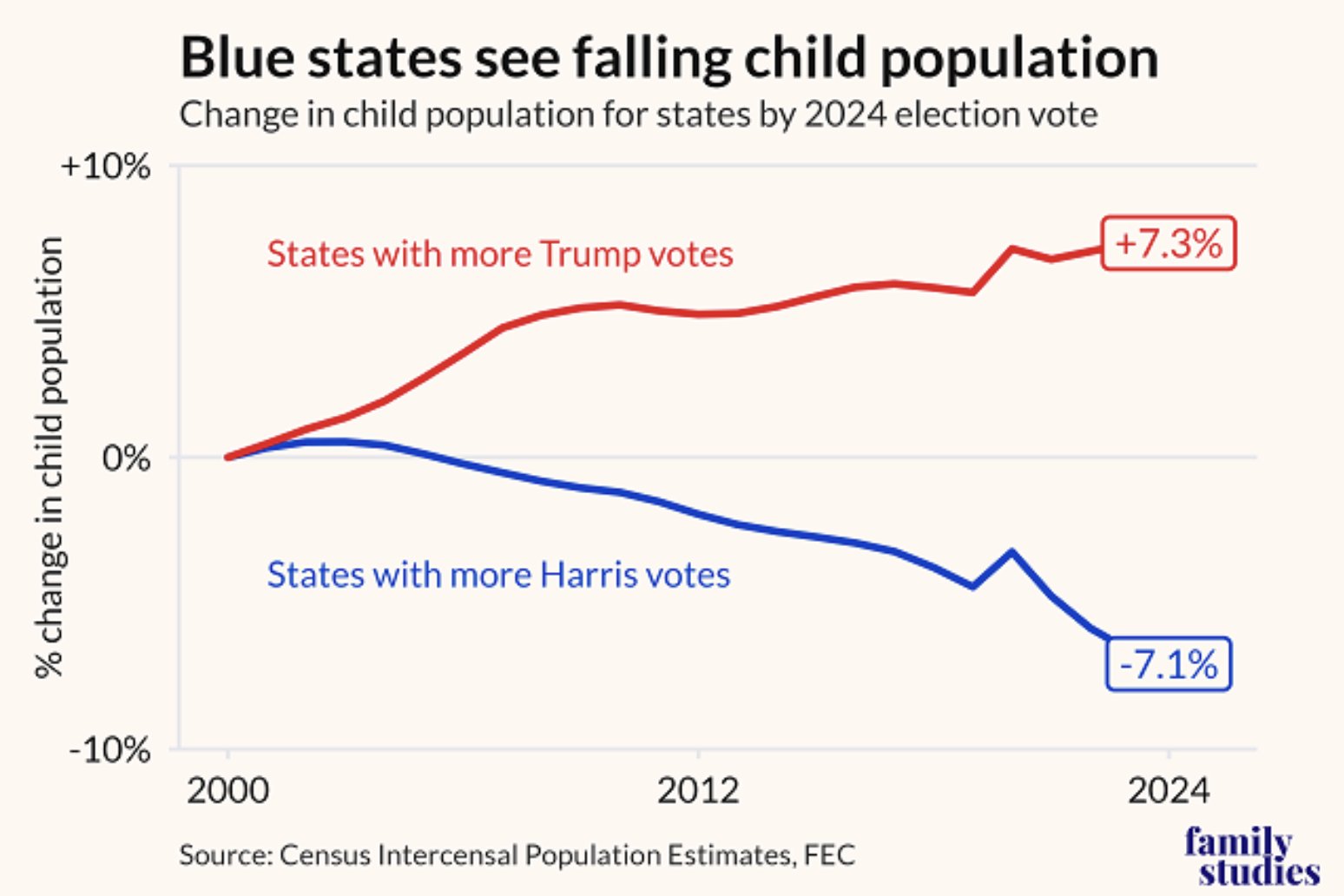
Via Brad Wilcox: "Since 2000, [red states] have experienced a 7% increase in their child population, whereas [blue] states have experienced a 7% decrease. These trends suggest a supportive economic & cultural climate for families trumps progressive family policies on offer from many blue states." Original source at the Civitas Institute at UT Austin.