9
Min read
Note: with the new year, we are experimenting with a new, more fluid, more informal, more opinionated format for the Briefing. Tell us what you think!
#Vaxxed?? — Let us say at the outset that this writer is fully convinced that the vast majority of vaccines are perfectly safe and good for you, and has not been pleased to see the antivaxx idea migrate from the fringes of the far left to the mainstream of the right, a phenomenon that was tragically perfectly predictable once senior Democratic politicians said they would not trust a vaccine approved by President Trump's FDA, and once public health authorities started deliberately lying about the Covid vaccine and trying to force people to take it in the service of a "herd immunity" strategy that they knew was unjustified since the vaccine does not stop transmission of the virus. We love our Trump Vaccine! Thank you President Trump for giving us the Great Vaccine!
With all that being said, the best argument that "antivaxxers"—we use scare quotes because a lot of people who are called that reject the label; in particular many say they don't oppose vaccines as a whole but are only skeptical about particular products or schedules, and we are sure they are sincere—but anyway, the best argument that "antivaxxers" have had is to point out that in the EU, there are much fewer vaccine mandates, and the vaccine schedule for children is much shorter.
And here we must admit to enjoying a little perverse trollish pleasure. Even before Covid, a certain kind of liberal demographic had already taken up vaccines as a kind of totem of Science Righteousness. Every Winter, they would proudly post on social media their little stickers about getting their Flu Shot, and ask yours truly if we'd taken our Flu Shot yet. To which we would innocently reply that we hadn't, as in France, the Flu Shot was not recommended for people under 65.
Which was and is perfectly true!
And makes perfect sense as public health. Unless you're a high-risk demographic, influenza won't kill you. So mobilizing a large infrastructure to give shots to people to merely avoid a mild inconvenience isn't a very good use of public money and energy.
But the question remains: why? Why does France have this policy, and why does the US have the opposite policy?
And the answer is obvious.
Say what you will about socialized health care systems—and we certainly agree they are less than ideal—the one thing they do is apply a very strict cost-benefit framework to any potential remedy. This is the pragmatic answer for why France focuses the influenza shot on high-risk demographics: not, or not primarily, because they have better science or wiser policymakers, but because it's more expensive, and in a socialized healthcare system, money is always tight.
And the answer for why public health authorities in the US have gotten themselves into the habit of convincing 25 year old anthropology grad students that they are striking a blow for Science(tm) by getting a shot they, in all likelihood, don't need is also obvious, right? In the US, Big Pharma is one of the biggest spenders on lobbying and government influence, and in the American system, what Big Pharma wants, Big Pharma usually gets. And so vaccines, a wonderful tool of science of public health, are trivialized for the sake of money.
This is not trivial, and goes beyond the problem of allocation of scarce resources. As we have learned since 2022, telling people they need to take a vaccine that, empirically, they don't really need to take, weakens the case for vaccines in general.
And so, in a nutshell, is why we are not particularly exercised about the new recommended vaccine schedules announced by HHS. Were the vaccines that have been removed from the schedule harmful? No, almost certainly not. But was their presence on the schedule probably more due to special interest lobbying than pure science? Probably yes.
#Fraud — By now you have probably been appraised of the latest developments in Minnesota. The Administration's announcement of a new position of Assistant AG for Nationwide Fraud Enforcement is very welcome news. For too long, the American taxpayer has been treated as a bottomless ATM for a "non-profit" cartel and a class of administrative grifters. By elevating fraud from a back-office bureaucratic concern to a direct White House priority, the Trump administration is signaling that the era of enforcement by elective neglect is over. We are moving from a passive, complaint-driven model to a proactive, mission-driven one.
Implementation should prioritize what we would call "administrative friction." Instead of a purely reactive, prosecution-only model, the new AAG should use their nationwide mandate to coordinate with Treasury and HHS to implement real-time audit triggers on high-risk disbursements. By leveraging FinCEN to flag suspicious patterns before funds are fully cleared, using the Minnesota experience as a template for hotspot identification, DOJ can move from chasing money after it has been offshored to freezing it at the source. This requires no new legislation, only the political will to mandate data-sharing agreements across agencies and the AAG’s exercise of the "directing" authority over US Attorneys that is already inherent in the office.
#TheEconomy — Vice President JD Vance recently gave an interview to Fox News's Jesse Waters. Two things we noted during the interview.
The first was that when Waters asked him to name the best thing about the economy, the Vice President boasted that the Administration had reduced the trade deficit by more than 60%. Traditional economists will scream, but that's not what interested us. What interested us is that when Vance gave an interview to Ross Douthat eight months ago, and Douthat asked him to name one criterion for success for the Administration's economic program, he replied: reducing trade deficits. It's nice to see government leaders name a specific goal ahead of time and then hold themselves to it.
The second is that Vance was asked about housing affordability for young people. While he endorsed the goal, he also said that the goal of the administration was to "thread the needle" by increasing supply while allowing current homeowners to "preserve the wealth" they have built up, which seems a little contradictory… Nicolas (30 ans) weeps… But then again, it's a politically realistic.
#AI — The President signed an EO federalizing state AI regulation. Good move. Whether it will stand up to the courts is another question…
#LGBT #Sanity — Very good observation from law professor Jeremy Christensen: "Riddle me this. Four major Big Law firms are counted on the side that thinks men have a legal right to play in women's sports.
"There are zero major firms on the other side. Some good boutiques, no doubt, but oddly these small firms are even representing multiple amici in the case filing separate briefs (a weird thing before SCOTUS). Not a single Big Law firm to be found to represent these amici seeking to weigh in on an issue that is 80/20 in the normal world.
"Think about that."
Indeed. Think about that.
#Apprenticeships — Here's a good announcement from the notoriously sane Democrat, Rep. Marie Gluesenkamp Perez: "There's no AP credit available for shop classes, so lots of kids have to give up something they're really good at to keep their college applications competitive.
"I got an amendment included in the LHHSE Appropriations bill to expand options for college credit for technical classes like welding and woodworking, and I'll continue engaging with the Dept. of Education to keep the ball rolling."
For decades, the American meritocracy has operated on a college-for-all consensus that is as economically ruinous as it is socially corrosive. We currently subsidize a vast archipelago of humanities degrees that often yield little more than credential inflation and ideological debt, yet we leave the technical mastery required to maintain our industrial base to fend for itself. By expanding college credit for shop classes, this might create a "Middle Class Track" that actually works, allowing students to stack credentials and enter the workforce with both high-level skills and reduced debt burdens.
#RuleOfLaw — Former President Bill Clinton, under federal subpoena, did not show up for his deposition with the House Oversight Committee today. This is clear Contempt of Congress. Steve Bannon and Pete Navarro went to prison for this.
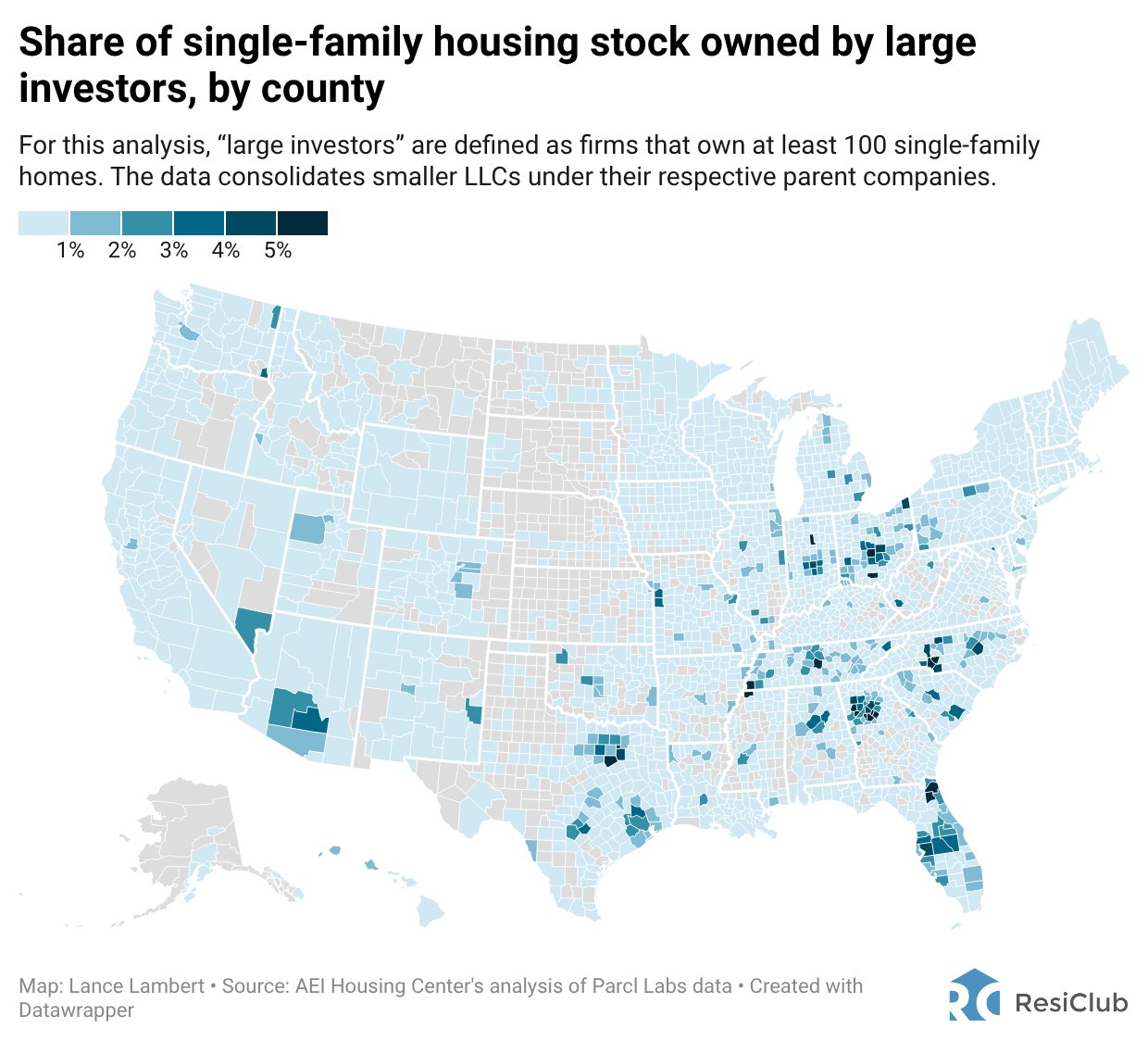
Chart of the Day
Good chart showing the share of single-family housing stock owned by large investors, by county, from Residential Club Analytics. President Trump's decision to ban large investors from buying such housing has been panned by Very Serious People under the logic that large investors own a very small share of the housing stock and therefore this won't do anything to prices. This may be true at the national level, but this map suggests the policy may make a real difference in a number of metro areas. On this map, we spy the Phoenix metro, Las Vegas, Houston, Atlanta, Charlotte, much of Florida, and Central Ohio… Not nothing.