10
Min read
If you are reading the mainstream coverage of the Trump Administration’s newly released "Great Healthcare Plan," you are likely seeing the usual headlines: drug price slashes, "TrumpRx," and populist rhetoric about transparency. These are, to be sure, significant measures. The codification of "Most-Favored-Nation" deals to match foreign drug prices in legislation would be a genuine disruption of the pharmaceutical status quo.
But if you stop there, you are missing the forest for the trees. You are missing the single most radical, transformative, and frankly dangerous (to the incumbent interests) element of this package.
The signal is buried in the section innocuously titled "Hold Big Insurance Companies Accountable".
As the sharp-eyed analyst Crémieux Recueil recently observed: "The most important thing in this package is that the White House is now going after Obamacare's Medical Loss Ratio requirement. Ending the MLR will enable a revolution in healthcare and it will constitute the largest anti-trust action in American history."
He is entirely right. And to understand why, we need to peel back the layers of what the Administration calls the "Plain-English Insurance" Standard.
To the layman, the Medical Loss Ratio (MLR)—often called the "80/20 rule"—sounds like a pro-consumer triumph. It mandates that insurance companies spend at least 80% (or 85% for large groups) of your premiums on actual medical care, leaving only 20% for administration, overhead, and profit.
It may sound good, but in practice, the MLR has functioned as a government-enforced cartelization of the insurance industry. By capping profit margins as a percentage, the MLR created a perverse incentive: the only way for an insurer to increase their absolute profit is to increase the total cost of care. If you are limited to 15 cents of profit on every dollar, you would much rather that dollar become two dollars.
This turned major insurers into "cost-plus" contractors. They lost the incentive to fight for lower provider prices. Worse, the administrative burden of MLR compliance decimated smaller insurers who couldn't spread those compliance costs, leading to the massive consolidation we see today. The "Big Three" didn't suffer from MLR; they were entrenched by it.
President Trump’s plan doesn't lead with a dry legislative repeal of the MLR provision—that would die a boring death in committee. Instead, it weaponizes the data to build the political capital for its destruction.
The plan explicitly demands that companies "publish the percentage of their revenues that are paid out to claims versus overhead costs and profits" on their websites. It demands they do this in "plain English—not industry jargon".
Why does this matter? Because the Administration is betting that when the American people (and, crucially, new market entrants) see the raw numbers of the "overhead" vs. "claims" game without the fog of regulatory accounting, the "Cost-Plus" racket will be exposed. The plan frames this explicitly as a move to "Hold Big Insurance Companies Accountable".
By targeting the MLR—initially through aggressive transparency and public shaming of "overhead costs", and strategically through the "Cost-Sharing Reduction Program"—the White House is launching a de facto anti-trust operation.
This is not just "deregulation" in the abstract Republican sense. It is the use of executive power to shatter a government-created oligopoly. It remains to see how the implementation works, but it's a powerful idea.
#NGOBlob — Over at The Free Press, Gabe Kaminsky has written a long reported piece on the Trump Administration's attempts to attack the left-wing NGO blob—perhaps the most important thing the administration can do. The summary of the piece is that the effort has floundered because of "legal constraints" and "donor backlash." If so, it's a tragedy.
#NGOBlob — Well well well. "Unearthed filing shows top teachers union funneling millions to far left orgs."
#NGOBlob #Fraud — Astonishing headline: "Biden admin likely paid out $84.6M in error for Minnesota housing assistance — including to hundreds who were already dead." In error. Uh huh.
#PublicHealth — Very good news: US overdose deaths fell through most of last year.
#Sanity — We are always on the lookout for sane liberals. And so, with no illusions, we are nevertheless happy to share this profile of Rep. Gluesenkamp Perez by the New York Times' James Pogue, talking about how she "thinks Democrats have lost their minds." No illusions, because we know Rep. Gluesenkamp Perez is a lot less moderate than she makes her image out to be, and because we know this attacking her own side is part of a campaign in one of the most vulnerable districts in the country. Still! Again, we're genuinely happy these discussions are taking place. It's still good to put these things on the record.
#Homeownership — CEA chair Kevin Hassett has told Fox Business: "We’re going to allow people to take money out of their 401(k)s and use that for a down payment… The president will put the final plan out in Davos next week." People can already take money out of their 401(k)s, but they have to pay a penalty, so presumably the proposal is to eliminate or reduce that penalty. Two obvious problems with this proposal. First, this would require changing legislation, which in the current environment seems unrealistic. The 10% early withdrawal penalty (along with its existing exceptions) is codified in Section 72(t) of the Internal Revenue Code. And second, the majority of people with enough money in their 401(k)s to use it towards a downpayment are already in their 40s or 50s. Still, we await to see the full proposal.
#PublicHealth #Screwworm — We've written previously about the scourge of the New World Screwworm, which destroys livestock. The larvae of the screwworm burrow into the living flesh of livestock and humans alike, feeding on wounds with screw-like teeth and capable of killing a host within two weeks. A public health effort, flooding the Panama Canal zone with specially bred natural predators, has been keeping it from the Northern half of the hemisphere for decades. But the crisis of competency has depleted that barrier, and the screwworm is making its way north. Now, Border Report reports that 8 new new cases have been reported in the Mexican border state of Tamaulipas. Texas Agriculture Commissioner Sid Miller warns that the rapid detection of cases suggests established populations may already exist just south of the Rio Grande, posing a catastrophic risk to the cattle industry. This is no longer a theoretical risk but an immediate test of government competence: if the federal bureaucracy cannot execute a rapid containment strategy, we face a significant economic and public health disaster.
#Immigration — The US has recorded negative net migration in 2025 for the first time in 50 years. This is an important milestone and marker of policy success.
Friday Essays
"Cartoons Hate Her" is a female influencer who is married with kids. Even though a self-described liberal, she can also be surprisingly realistic and honest about gender dynamics, marriage, and parenting. Hence, we are happy to recommend her much-needed essay, whose title is self-explanatory: "Modern Marriage Isn't Misery."
Not only most Americans, but the majority of conservative legal scholars, or close to it, take for granted the idea that the Fourteenth Amendment established birthright citizenship in the US, was intended to do so and has been consistently interpreted to do so. In his fascinating history of birthright citizenship, for Compact, a magazine that has been hitting it out of the park lately, legal scholar Ilan Wurman shows that it very much hasn't been the case.
Speaking of: also in Compact, here is the great social scientist Charles Murray, whose most recent book is about his late-life reconciliation with religion after lifelong unbelief, telling us "How I Changed My Mind On Assisted Suicide."
Ok, we swear we're not being paid by Compact. But here's another excellent essay. This time, Helen Andrews, with a timely look at the fraud and scandals in Minneapolis, and a scholarly account of how they map with the tribal and cultural patterns of Somalia.
Andrews has also written, this time for the Claremont Review of Books, a powerful reflection on the life and murder of Charlie Kirk, "a once-in-a-century talent who will not be replaced."
At National Affairs, Charles Fain Lehman, perhaps the best criminologist in America, has published an important essay: The Case for Prohibiting Vice. In a political culture soaked with folk libertarianism, it's important to make the philosophical argument before discussing particular vices. "The modern push for vice legalization does not come from nowhere; it depends upon a previously laid theoretical and legal groundwork. At its deepest extent, it is built on John Stuart Mill's articulation of the 'harm principle.' As Mill put it in On Liberty, the principle asserts that 'the only purpose for which power can be rightfully exercised over any member of a civilized community, against his will, is to prevent harm to others. His own good, either physical or moral, is not a sufficient warrant.'"
Chart of the Day
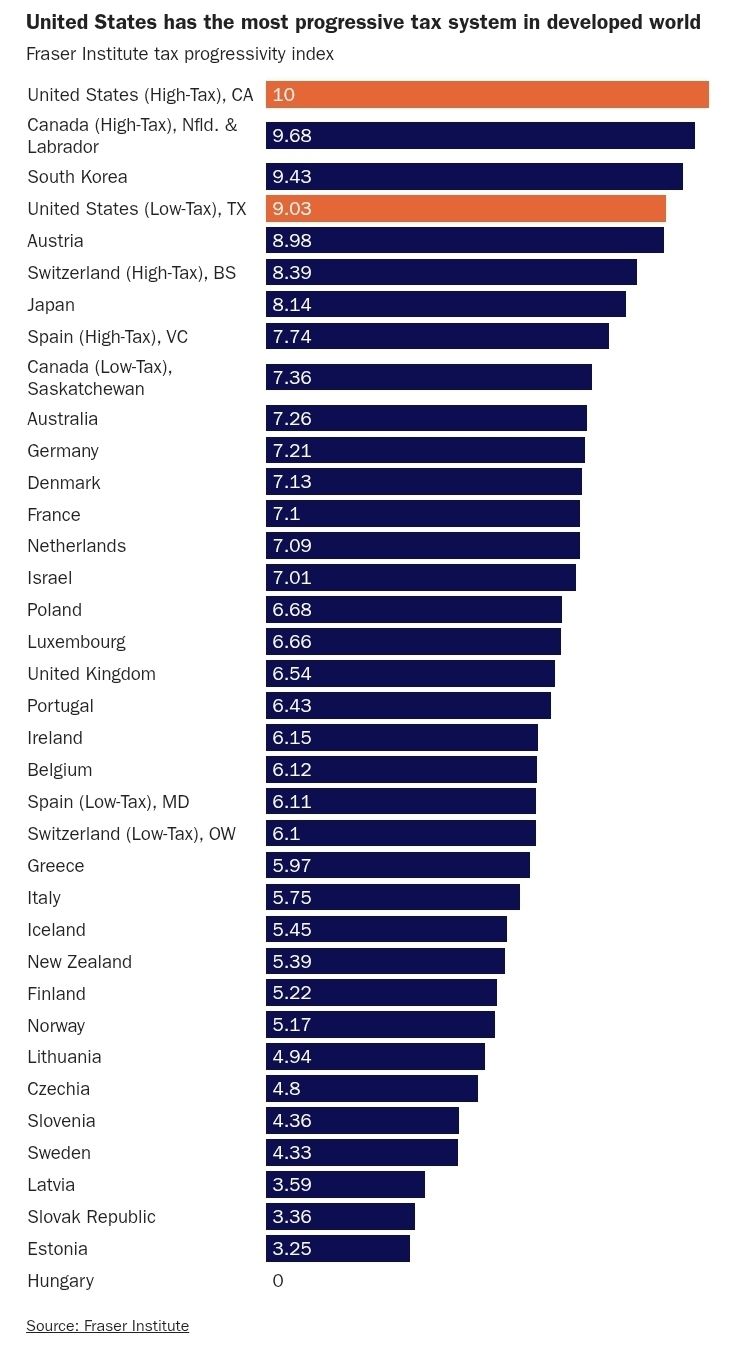
"US has the most progressive tax system in the developed world," says Cato.