7
Min read
Note: with the new year, we are experimenting with a new, more fluid, more informal, more opinionated format for the Briefing. Tell us what you think!
#RealFood #TakeTheFrenchPill — If you ever needed more proof that the French are always right…
HHS and USDA released the Dietary Guidelines for Americans, 2025–2030, and effectively rebranded the public-facing "how to eat" message around a new hub: RealFood.gov. The headline is as blunt (and truthful) as Washington ever gets: "eat real food."
Substantively, the document is short (10 pages) and deliberately legible. It's aimed at everyday Americans for use, instead of being written in bureaucratese. Its core moves are easy to summarize:
First, protein is no longer treated as a guilty pleasure but as the anchor. The Guidelines set a protein goal of 1.2–1.6 grams per kilogram of body weight per day. That is a notable shift from the long-standing "minimum to avoid deficiency" benchmark of 0.8 g/kg/day that federal reference tables use.
Second, the Guidelines elevate full-fat dairy (no added sugars) and explicitly steer households toward "healthy fats" from whole foods, while still reiterating that saturated fat should stay under 10% of total calories. In practice, the text reads like a détente between mainstream advice and what the gym corner of the internet has been saying for a decade: stop mainlining refined carbs and snack foods; prioritize satiety and muscle; don’t be afraid of eggs, yogurt, and steak—and don’t pretend donuts are "fine in moderation" if they’re daily.
Third, added sugar gets a simple, concrete rule: no more than 10 grams of added sugars per meal. That replaces the older guidance that framed sugar as a share of daily calories (for 2020–2025, "less than 10% of calories/day" starting at age 2). The new version also takes a harder line on non-nutritive sweeteners and certain additives (artificial flavors, petroleum-based dyes, preservatives), again echoing “bro science” skepticism—sometimes clumsily, but not always wrongly.
Fourth, the document wages open war on “highly processed” foods and refined carbohydrates, while still endorsing fiber-rich whole grains. This is the part that is most supported by mainstream science. The evidence base linking ultra-processed diets to overeating and weight gain is not just epidemiology: an NIH inpatient randomized trial found that participants eating an ultra-processed diet consumed more calories and gained weight compared with an unprocessed diet. Large umbrella reviews also associate higher ultra-processed intake with worse cardiometabolic outcomes.
Fifth, the Guidelines nod toward metabolic reality by stating that some individuals with chronic disease may do better on lower-carbohydrate diets—language that would have been unthinkable in an earlier era of government nutrition orthodoxy. That is "bro science" meeting the clinic: not everyone needs keto, but many patients with obesity and type 2 diabetes do need fewer refined carbs, more protein, and a plan that keeps them full.
Sixth, and most amazingly, the Guidelines drop the familiar one-drink/two-drink daily limits. Here's Dr Oz on the guidelines: "Alcohol is a social lubricant that brings people together...there's nothing healthier than having a good time with friends," adding that "there was never good data" to back the 1-2 drink guideline. (Via Brent Scher) All we can say is: oui, c'est vrai.
One caution flag: the term "highly processed" is rhetorically powerful and administratively slippery: policy has to define it without accidentally blacklisting practical, nutritious staples (frozen vegetables, canned beans, plain yogurt). Implementation will matter.
That being said, this is a huge step forward for public health, and one hard to imagine in any other administration than this one.
#Housing — A new announcement just dropped: President Trump said he is “immediately taking steps” to bar large institutional investors from buying additional single-family homes, and will ask Congress to codify the restriction. In a Truth Social post, the President framed the move as a direct response to the erosion of homeownership affordability—especially for younger Americans—and as a corrective to the growing "financialization" of the housing market, where neighborhoods increasingly compete not against other families but against well-capitalized balance sheets. Aides say more detail will follow alongside broader housing-and-affordability proposals in an upcoming speech in Davos.
For national conservatives and working-class populists, the case is straightforward: single-family homes are not just an asset class, they are the physical foundation of family formation, neighborhood stability, and civic belonging, and public policy should treat them accordingly. Even if institutional buyers are not the only driver of high prices (scarce supply, zoning, and the cost of capital matter), the political economy is unmistakable: when large pools of capital can systematically outbid households, the result is a ratchet effect that shifts communities from owners to renters and converts local life into an extractive revenue stream. The practical implication for Republican governance is to marry this demand-side guardrail with a pro-family supply agenda—faster permitting, more entry-level construction, and infrastructure that opens up buildable land—while designing enforcement that targets true institutional accumulation (large funds and corporate aggregators) without punishing small landlords, builders, or ordinary investors. Codification would also matter: it would make the policy durable, reduce regulatory whiplash, and signal that the GOP intends to govern on behalf of working families rather than financial intermediaries.
#ChildTrafficking — Important piece from Phillip Linderman: it has been an open secret that during Operation Allies Refuge (the July–August 2021 Afghanistan evacuation), US processes effectively enabled child trafficking, especially through forced "marriages" used to secure evacuation access, and that officials dismissed or minimized warning signs. He cites AP reporting from the “Humanitarian City” hub in Abu Dhabi, where girls alleged sexual assault and coercion into marriage by older Afghan men, and notes similar allegations among evacuees processed at Fort McCoy, Wisconsin.
Linderman places significant blame on State's Afghan resettlement office (CARE). A State cable described multiple cases of minor females presented as "married" to adult men and requested urgent guidance; it was met by a response characterizing the claims as merely "anecdotal." He also highlights whistleblower and investigative findings that standard vetting steps were bypassed—and, in some cases, that staff were directed to push files forward despite apparent name matches in terrorist/criminal databases.
Linderman argues that DHS should investigate these abuses and bring those responsible to justice. Amen.
#Apprenticeships — DOL has announced a forecast notice for an upcoming $145 million funding opportunity to expand the national Registered Apprenticeship system through a pay-for-performance incentive payments program. The department says this is its most significant investment to date tied to President Trump’s directive to meet and exceed 1 million active apprentices nationwide, with taxpayer dollars linked to measurable outcomes. The Employment and Training Administration expects to make up to five cooperative agreements, each with a four-year performance period, supporting both newly developed Registered Apprenticeships and the growth of existing programs across industries, with particular emphasis on sectors that already have strong apprenticeship infrastructure.
The money is good, but also of interest here is the model: pay-for-performance is the right instinct because it aligns federal spending with results rather than inputs, and it nudges the system toward scale by rewarding what works. If implemented well, this can help normalize apprenticeships as a mainstream workforce strategy not just in the traditional trades, but in areas central to American industrial strength and national competitiveness, such as advanced manufacturing, maritime, nuclear, and the next wave of tech-adjacent skilled roles. The key will be disciplined metrics (completion and job outcomes, not check-the-box activity), low-friction administration, and an approach that treats intermediaries as builders of employer-led pipelines rather than as substitute managers of training. Done right, this is a practical, pro-worker, pro-growth lever that deserves active engagement from governors, state workforce leaders, and major employers looking for durable talent pipelines.
#Energy #Nukes — DoE announced a $2.7 billion, ten-year push to rebuild US uranium enrichment, an essential chokepoint in the nuclear value chain-, awarding three $900 million task orders to American Centrifuge Operating and General Matter to stand up domestic HALEU capacity, and to Orano Federal Services to expand domestic LEU enrichment, with awards gated by strict milestones; DOE also added $28 million for Global Laser Enrichment to advance next-generation enrichment technology. If the admin is serious about a "nuclear renaissance" it cannot outsource the fuel cycle to foreign suppliers. The key now is execution and oversight—tying dollars to deliverables, accelerating the industrial base and procurement pathways that create durable demand for both today’s fleet (94 commercial reactors) and advanced designs that will require HALEU, and ensuring this investment translates into real, scalable domestic capacity rather than another well-intentioned program that dies in the valley between pilot and production.
#VotingRights — DOJ is suing Arizona and Connecticut for failing to produce their full voter registration lists upon request. Astonishing fact: "This brings the Justice Department’s nationwide total to 23 states and the District of Columbia." Truly, nothing is rotten in the Kingdom of Denmark…
#DrillBabyDrill — DOT takes over Deepwater Port Licensing. Previously overseen by the Coast Guard, deepwater ports are where oil tankers dock while receiving offshore oil and gas. Licenses for offshore oil in the Gulf of America are already in progress so delegating licensing for the necessary ports to a federal agency will hopefully match the pace of development.
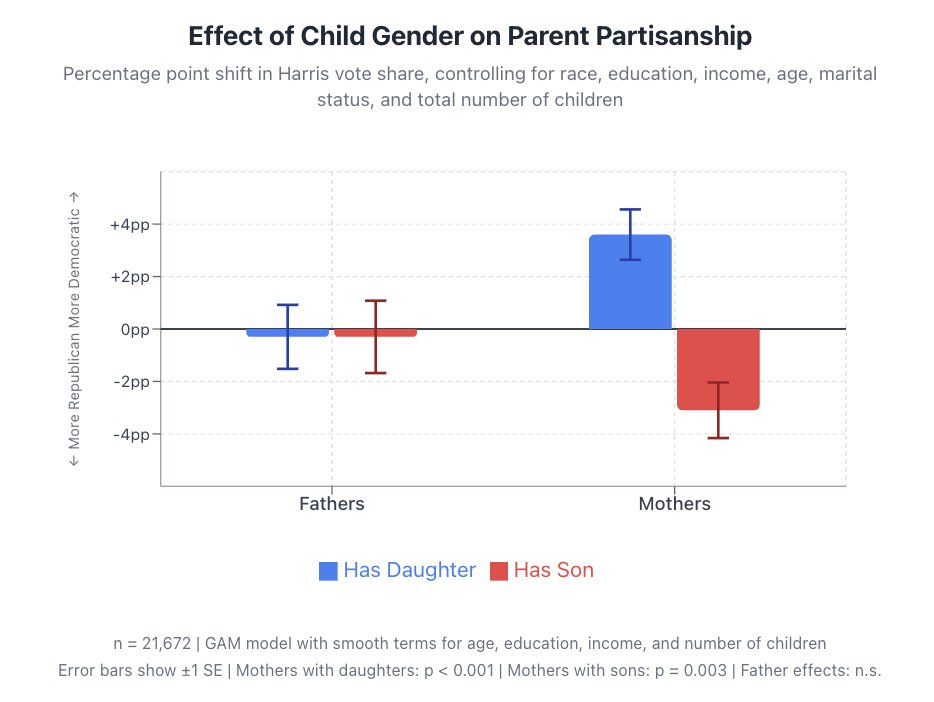
Chart of the Day
Fascinating chart from the last sane liberal, political analyst David Shor, on the effect of child sex on parent partisanship. He writes: "Because child gender is ~ random, we can estimate the causal impact of being a "boy mom" vs "girl mom" by conditioning on # of kids. Mothers with sons are ~3% more Republican, while mothers with daughters are ~4% more Democratic. Child gender has ~ zero effect on fathers." (Wisely, Lyman Stone of the Pronatalism Initiative adds: "Given abortion and prenatal ultrasounds, child gender is not actually random.")