8
Min read
Apologies for our erratic posting lately, which has been due to your correspondent working on special projects. The Briefing will be off next week because we will be engaged in a study trip which we hope to tell you more about later.
#Institutions — One of the most intelligent people we know (and a friend of PolicySphere) is Yuval Levin. Which is why it's noteworthy that he gave a long interview to Ezra Klein discussing the Administration after one year. He is often a critic of the Administration, but a constructive, intelligent critic.
He argued that while the administration maintains a high "muzzle velocity" of news and spectacular events, its actual achievement of durable, long-term policy change is more constrained than it appears.
Levin also highlighted a fundamental shift in how the White House functions and how it interacts with the country: he notes that decisionmaking is a lot more centralized now. Stephen Miller is described as the "most powerful policy staffer in the history of the modern White House," serving essentially as a "prime minister" through whom almost everything flows.
He also argued that the admin uses the federal government as a "cudgel" to drive behavioral changes in institutions. This has undermined the sense of the U.S. government as a reliable, predictable partner, forcing entities like universities to realize their funding depends on the president’s personal priorities—we would debate this.
The most interesting part to us, however, was Levin's distinction between "activity"—being at the center of news cycles—and "action," which he defines as the traditional use of presidential power to create lasting change.
He defines "activity" as the president’s ability to dominate the news cycle and govern "retail" by focusing on the issue of the day to ensure he is at the end of every story. This approach relies on one-off deals—such as individual agreements with universities, drug companies, or specific tech firms—which provide immediate, graspable headlines but lack the permanence of systemic reform. These "retail" moments allow institutions to behave defensively, making small concessions to avoid more significant, long-term regulatory shifts, which Levin views as a form of short-termism that preserves the administration's freedom of action at the expense of broad, effective governance.
In contrast, Levin identifies "durable action" as the "wholesale" use of traditional presidential power through legislation, formal rule-making, and administrative procedures. He notes that while activity feels fast, actual action is often "dull and lawyerly," requiring years of public comments and legal processes to create changes that truly endure. By this metric, the administration appears underactive: Trump has signed fewer pieces of legislation than any modern predecessor and has moved at a slower regulatory pace than the last five or six presidents. The lack of a clear legislative agenda and the failure to change underlying federal spending levels—which actually increased by 4% in 2025—demonstrate that spectacular activity often serves as a substitute for, rather than a driver of, lasting institutional change.
Here's our commentary. Many of Levin's points are well-taken.
We would say two things.
On the point about centralization of decisionmaking, the reason for this is quite clear: there is a shortage of highly competent, highly aligned people to staff the Administration. We know this. This means that policymaking must be centralized among those who demonstrate this level of competence and alignment. The memes about Marco Rubio doing every job in America is obviously a result of this: Secretary Rubio is both highly competent and highly aligned with the Administration, and so he keeps getting more jobs. On the domestic front, this is also true of staffers like Miller (and others). In the immortal words of then-Defense Secretary Rumsfeld, you go to war with the army you have, not the army you wish you had. To continue the metaphor, the President is actually fighting the war, instead of throwing his hands up, which was the practice of many past Republican administrations when they hit an institutional or political or staffing roadblock.
On the point about "activity" versus "durable action," his point is also very well taken, but the invisible word there is "Congress." We all know why Congress is stuck, and it boils down to the filibuster. There are many good bills that could get 53, 52, 51, 50-plus-a-VP-tiebraker votes but will not pass.
That nature abhorrs a vacuum is not just a law of physics, it is also a law of politics. For constitutionalists who are uncomfortable with the Administration's vigorous use of executive power, we would argue that it is actually a wholesome feature of the American constitutional system of checks and balances: a branch increases its power to the extent that the other branches abandon power.
Tariffs are a good example. Many decades ago, Congress delegated some tariff-making authority to the Executive Branch. Did they envision, at the time, the very aggressive and unpredictable way that President Trump would use those powers? Almost certainly not. Then what? Well, if Congress is unhappy with the way the President is using his delegated tariff-making authority, Congress can take it back. Literally. If Congress is truly unhappy with this use of power, it can stop it. It can literally stop it next week. Of course, it won't, for the same gridlock reasons that prevent it from passing legislation. But that's the point: it absolutely could. But it won't. And therefore the tariff-making will continue. This is the Constitutional system working as it was designed. The Congress could at any moment check the President, but it is choosing not to.
Again: the President and the Administration are going to war with the army they have. For example, we know they want to work with Congress on topics like healthcare and discretionary spending levels. Do you think Congress will pass an ambitious healthcare bill this year? Why not?
Chart of the Day
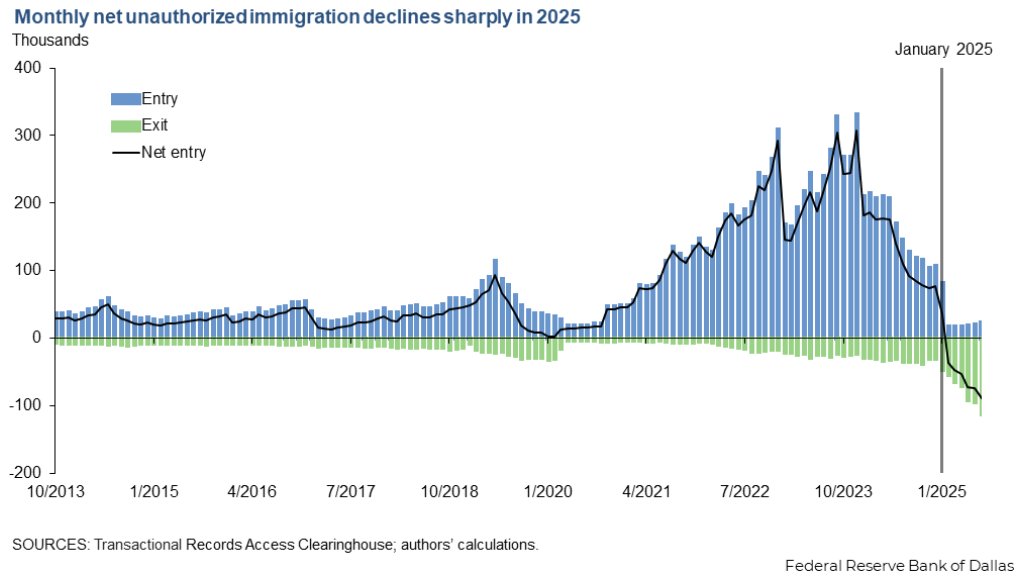
The Dallas Fed, with the understatement of the year: "U.S. net unauthorized immigration has rapidly declined, turning negative in February 2025. The contraction follows a rapid increase from early 2021 to early 2024." Via Jim Pethokoukis.